
The vulnerability of nuclear plants during military conflict.
Nuclear Power in Times of Conflict.
Risk of unprecedented nuclear disaster if Russia’s attacks on Ukraine’s electricity system continue
Analysis by Greenpeace Central and Eastern Europe
Authors:
Nuclear experts of Greenpeace office in Ukraine:
Jan Vande Putte (Jan.Vande.Putte@greenpeace.org)
Shaun Burnie (sburnie@greenpeace.org)
Introduction
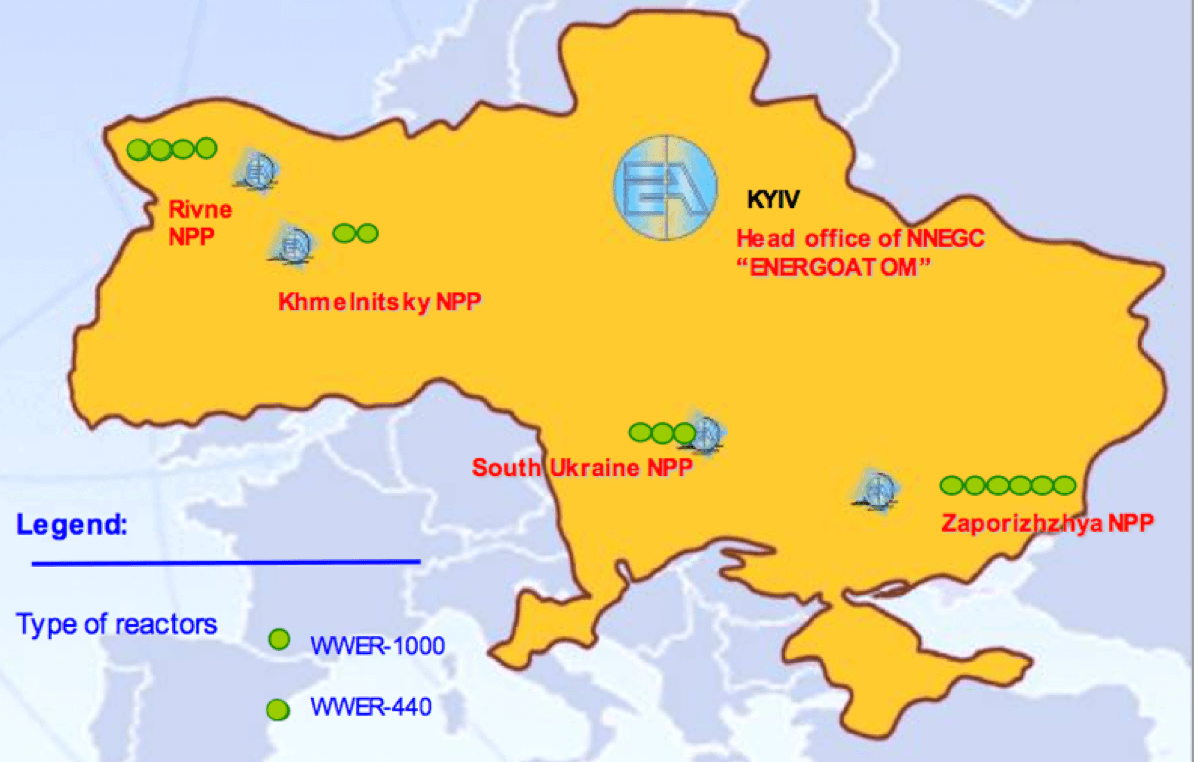
The nuclear safety and security crisis in Ukraine is entering a uniquely dangerous phase. Russia has targeted Ukraine’s energy infrastructure with military strikes, including its generation capacity and electricity substations. As a direct consequence, Ukraine’s national grid is damaged and weakened to an unprecedented level. Two and half years since Russia’s full-scale invasion, the occupation of Chornobyl in February 2022 and as well as the attack and continuing occupation of the six reactors at the Zaporizhzhia nuclear plant (ZNPP) in March 2022 – it is hard to imagine the energy crisis becoming even more severe. However, as a result of Russia’s war on Ukraine, the entire safety program of Ukraine’s nuclear reactor fleet – a total of 15 reactors - and electricity supply across the nation is at a heightened risk of potentially catastrophic failure. Most at risk are the people and the environment of Ukraine, but there is the potential for much of Europe and beyond to be severely impacted. The current analysis attempts to explain what risks a war can pose on operational nuclear safety, and shows the possible dire consequences if Russian attacks continue on Ukraine’s remaining electric system.
Recent developments that heightened nuclear risks in Ukraine
While the six Zaporizhzhia reactors under Russian military occupation remain on a cliff edge in terms of safety, they are at least in cold shutdown. As such, even with the loss of electrical power and cooling function, it would be several weeks before the release of radioactive material would be envisaged. The same cannot be said of Ukraine’s nine reactors which continue to operate at Rivne, Khmelnytskyi and South Ukraine. These reactors are currently the primary source of electricity in Ukraine, since the Russian military attacks have incapacitatedmost of Ukraine’s non-nuclear generating capacity, which traditionally helps maintain stability in the power grid.
Recent reports from the President and Foreign Minister of Ukraine have raised the spectre of plans by Russia to further target Ukraine’s electricity infrastructure, and in particular the electrical sub stations and nuclear reactor switchyards. Sub stations, which serve for the transmission of electricity, are also vital to maintain the functioning of Ukraine’s energy network and to maintain the operation of Ukraine’s nuclear reactors.
Since Russia’s full-scale invasion in February 2022, Ukraine’s energy infrastructure has been under repeated attacks, which on occasions have led to nuclear power plants (NPP) suffering Loss Of Offsite Power (LOOP), including on 22 November 2022. During the period 2022-23, about half of Ukraine’s power generation capacity was lost either due to occupation by Russian forces, or because they were destroyed or damaged, and approximately half of the large network substations were damaged by missiles and drones. Remarkably, Ukraine’s electricity grid remained functional and still sufficiently robust to withstand severe consequences. This means that the rapid restoration of grid connections to nuclear power plants suffering loss of grid connection was possible, and there was sufficient electricity generation capacity in the grid to allow the restart of shutdown reactors. However, the escalation of Russian attacks from March 2024 meant that by the end of summer 2024, 95 percent of Ukraine’s thermal power plants had been destroyed or severely damaged.
The attack by Russia on Ukraine’s grid on 26 August 2024 forced four reactors to be disconnected from the grid and therefore relied solely on onsite power. If Russian attacks continue to target Ukraine’s electric system, the future scenario for this winter is for more severe consequences in terms of energy supply across Ukraine.
The risks of a Station Black-Out (SBO)
When a nuclear power plant loses its offsite power from the grid, a so-called Loss of Offsite Power (LOOP) event occurs and the power plant falls back to three main power sources for its critical safety systems: on site batteries, back-up diesel generators, and the possibility to trip one reactor at the plant to house load. Batteries can supply electricity immediately, but only for a short period of time. The diesel generators have a stock of fuel onsite sufficient to operate for about ten days, but their continued operation over such a long period of time might be challenging, even if there is some redundancy in the number of generators. The trip to house load is a procedure to reduce the power of one reactor at the plant to about 10%, with sufficient electricity output to secure the electricity needs of the safety systems at the entire plant. However, experience has shown that this is a delicate procedure which does not always succeed. If all power supply fails, both offsite (LOOP) and onsite, then the plant enters a Station Blackout (SBO). For an operational nuclear power plant this can lead to the boiling out of the cooling water in the reactor vessel in a matter of hours, leading to core damage and releases of radiation within the reactor containment building, and further into the environment due to overpressure within the containment.
Even if nuclear power plants are designed to cope with a LOOP through their onsite power generation, a LOOP is a serious incident and is considered as a precursor to a SBO. Under normal power operating conditions, the risk of an SBO is a main contributor to reactor core damage at a nuclear power plant. The 2011 Fukushima-Daiichi nuclear disaster and the following nuclear power plant stress-tests around the world have also highlighted the central importance of the reliable electricity supply to the nuclear plant. And even faults on the grid system at a significant distance from a nuclear power plant can be the cause of reactor trips or the loss of offsite power.
An operational nuclear power plant requires significant amounts of power to maintain the cooling of the heat of the fuel in the spent fuel pools and the residual heat in the reactor cores after the shutdown of the reactor. Without the water circulation pumps functioning, the cooling water in the reactor core will boil out in a matter of hours and core damage will occur including fuel melt.
Major difficulties to recover from a black-out (black start)
A black start (or black-out recovery) is the complex process to restart the electric power system from a black-out. This process will be coordinated by the TSO (Ukrenergo) and requires a sufficient number of power plants with black start capability, such as diesel generators, Battery Energy Storage Systems (BESS), hydro-electric and thermal plants and hydro plants. BESS can be combined with variable renewable sources such as wind and solar. Nuclear power plants are not capable of a black start and are thus dependent on those other sources. This is particularly problematic in the Ukrainian context of today, because most of the hydro and fossil generation capacity has been incapacitated by the Russian aggression, and Ukraine does not have (yet) a significant BESS capacity.
Potential radiological consequences of a station blackout
Nuclear safety is complex and multi-faceted. It not only requires a stable nation-wide offsite electricity system, but also the availability of sufficient competent staff onsite and nation-wide logistics of supplies, such as fuel for diesel generators or heavy equipment in the case of an emergency. The 2011 Fukushima Daiichi nuclear crisis showed a massive logistical operation in Japan, in the midst of power cuts and the consequences of the 11 March magnitude 9.0 earthquake and resultant tsunami. In Ukraine there would be multiple related challenges in a nation-wide grid blackout. There would be difficulty in securing sufficient supplies to the three operational nuclear plants under Ukrainian control. The challenge to maintain onsite electricity production at the power plants after a LOOP , and a wider societal disruption of such a situation would also impact the staff. It is clear that this is far, far beyond the design basis of a nuclear power plant, and thus largely unknown territory in terms of how these different components interact systemically.
A nation-wide grid blackout could affect all four nuclear power plants which further complicates the emergency response management. It is necessary to restate that the current situation in Ukraine is on the edge of a nuclear crisis of unprecedented proportions in the history of nuclear power.
The state of nuclear safety in Ukraine
Not a single national nuclear power program in the world has been designed to cope with the scale of disruption the full-scale Russian war has inflicted on the territory of Ukraine. There is currently no existing safety analysis available for nuclear regulators worldwide that considers such a scale of a crisis in a national electricity grid and its consequences for nuclear power plant safety.
The social impact of Russia targeting Ukraine’s energy system
The nuclear safety and security threat posed by Russia’s military attacks should also be seen in the wider context of their impacts on the Ukrainian people. As the United Nations Human Rights Monitoring Mission in Ukraine (HRMMU), recently reported the “Russian attacks on Ukraine’s electric power system, damaging or destroying numerous power generation, transmission, and distribution facilities have had reverberating effects causing harm to the civilian population and the country’s electricity supply, water distribution, sewage and sanitation systems, heating and hot water, public health, education, and the economy."
In addition, there is the issue of the violation of the principles of international law. The United Nations Independent International Commission of Inquiry on Ukraine has already concluded that Russian attacks on electricity infrastructure in 2022-2023 were widespread, systematic, and disproportionate, constituting the war crime of excessive incidental civilian harm and potentially a crime against humanity.
With millions of Ukrainian citizens already displaced from their homes due to the Russian war, “the energy infrastructure attacks have caused additional population displacement and have disproportionately impacted groups in a situation of vulnerability, such as older persons, those with disabilities, households with lower incomes, and the internally displaced, with women particularly affected,” HRMMU warned. “The fragility of the electric grid during this coming winter will increase along with electricity consumption as Russian attacks continue. Ukraine will face a significant electricity deficit in the winter, with daily power cuts during the cold months leaving civilians without the electricity they need to power homes, run water pumps and allow children to study online.”
Read Analysis at Greenpeace